I tracked the wallets with 90%+ win rates on Polymarket. They're not predicting anything.
One wallet has won 92.9% of its trades. Another sits at 95%. Their secret isn't insight — it's a boring, repeatable pattern that almost nobody talks about. Here's exactly what they're doing.
I'm going to ruin Polymarket for you. Not because it's broken — but because once you see what the highest win-rate wallets are actually doing, you can't unsee it. And then you'll either start doing it yourself, or you'll wonder for the rest of the year why you didn't.
The wallets with the absurdly high win rates — the 90%, 93%, 95% wallets — aren't predicting anything. They're running the same boring play, over and over, and the public on-chain data exposes it in seconds. Once you understand it, you can do it too — manually if you have all day to babysit a screen, or with a bot if you don't.
Meet the wallet that's been winning for 455 days straight
Pull up Polymarket. Search this address:
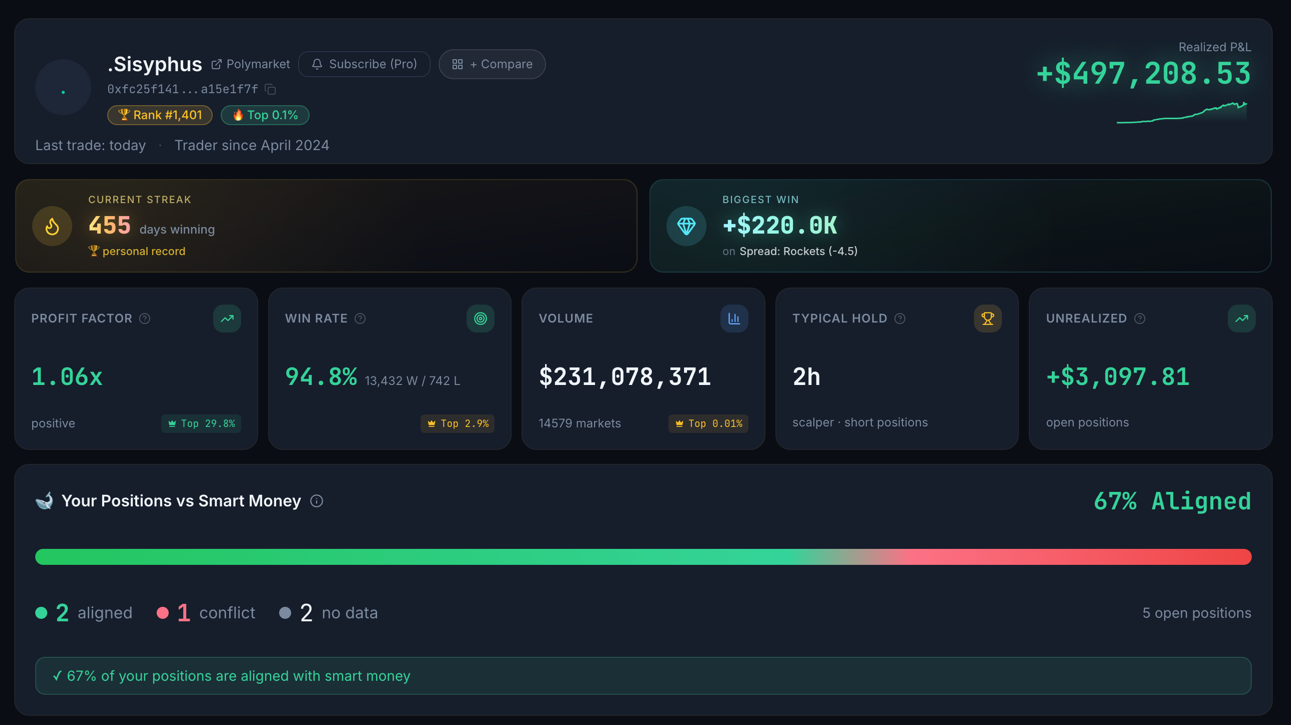
Sisyphus has been on a 455-day winning streak. Realized P&L of +$497,208. Lifetime volume of $231 million across 14,579 markets. Typical hold time: 2 hours.
That last number is the giveaway. Sisyphus isn't predicting elections. Sisyphus is not a forecaster. Sisyphus is opening positions, closing them two hours later, and doing this fourteen thousand times. Each trade is tiny. Together they print half a million dollars.
Average per-trade P&L: roughly $35. — Realized P&L of $497,208 ÷ 14,174 closed trades. Source: Orcalayer.
Thirty-five dollars. Per trade. That's the math the wallets at the top of the leaderboard are running. It looks boring because it is boring. It only looks impressive when you stack 13,432 of them.
Six wallets. Same pattern.
I picked Sisyphus because the 455-day streak is a useful headline. But Sisyphus isn't an outlier — the pattern repeats across every wallet at the top of the win-rate distribution. Six examples, pulled from public on-chain data, with their addresses verifiable on any Polymarket tracker:
All six wallets verifiable on any Polymarket tracker (HolyPoly, Predicts.guru, Polyburg). Stats snapshot from this week's leaderboard.
Look at the spread. Sisyphus grinds 14,000+ trades over two-hour holds. mangotree did the same with 49 positions. bobe2 has been doing it since 2022 and has $1.8M to show for it. Different styles, different time horizons — but every single one of them is sitting between 84% and 96% win rate. None of them is "predicting." All of them are exploiting the same structural feature of the market.
The tail-end signature — three on-chain tells
The play, in one sentence
Buy near-certain outcomes at 90–98¢. Hold to resolution. Collect $1.00.
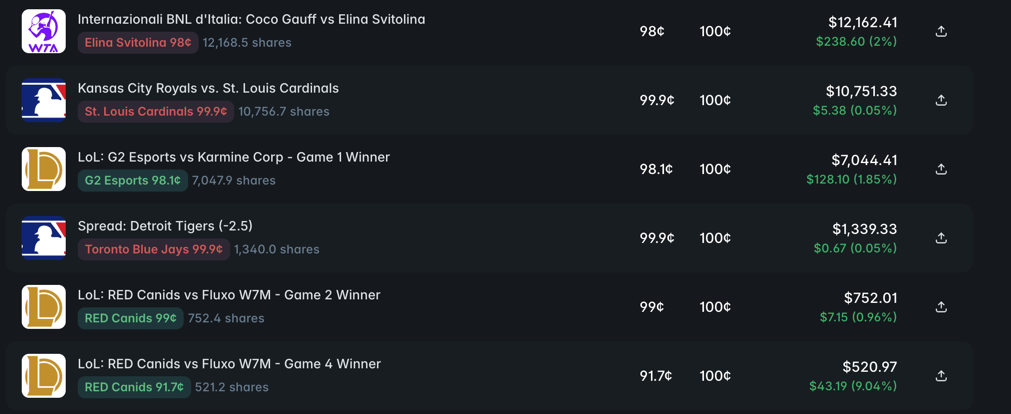
That's it. Every share on Polymarket settles at either $1 (if the outcome resolves your way) or $0 (if it doesn't). When a market is hours from closing and one side is trading at 95¢, the order book is telling you — collectively, with real money — that the outcome is virtually locked. Buy at 95¢, hold a few hours, take $1.00. You just made ~5.3% on the capital you committed.
Some people call it tail-end trading. On Telegram and in private group chats, it's just called "free money." The risk isn't zero — but the order book itself is telling you it's somewhere between 5% and 1% per trade. That's not a hot take. That's collective market consensus.
"Earning 1–5% per trade seems tiny, but in practice it's crazy efficient. A 5% return in 24 hours is basically 1,800% annualized — with very low volatility."
The catch is the part most people refuse to take seriously: the per-trade gain is microscopic. We're talking pennies on each individual share. To turn this into real money, you need two things — a high enough hit rate that the rare losses don't eat your gains, and enough volume of opportunities to compound. Sisyphus had to grind through 14,000+ trades to clear half a million. That's the trade-off.
Which is where most people stop reading and go back to gambling on the next election. Big mistake.
The math nobody runs
If you make 1% a day and compound it, what do you have at the end of a year?
Daily return → compounded over 365 days
You don't need 2% a day. You don't even need 1% a day. Half a percent compounded daily turns $10,000 into roughly $61,000 over twelve months. And on Polymarket, half a percent on a 95¢ bond is laughably easy to find — when you can find them in time.
Why retail can't run this strategy manually
Here's where my own story gets less glamorous.
I started doing this by hand. I'd refresh the "ending soon" tab three times an hour. I'd build little spreadsheets. I'd write Twitter threads to myself like "watch market XYZ resolves Friday." I'd miss half of them anyway because I had a job. The good free-money setups would appear and disappear inside of minutes — exactly because the bots running the leaderboard wallets had eaten them.
I won money. I won a lot less money than the math said I should. And I burned hours doing it.
The whales are not smarter than you. They have software running 24/7 that you don't have.
That's the whole secret. The strategy is sitting in plain sight in the documentation. The execution is what separates the wallets clearing five figures a week from the rest of us tabbing back to Polymarket between meetings.
So I started building.
What I ended up with
I just wanted a tool that would do for me what I would do for myself if I had no day job and infinite patience. That tool is now called Komi, and at the time of writing it does three things that, frankly, I wish someone had built earlier:
Three modes. One edge.
Insider trades feed
See every trade over $20K placed on low-probability odds — the moment it hits the chain. Big money going into unlikely markets is almost always a signal. You see it in real time, in your feed.
Whale trades
Track every trade above $50K in real time. When a wallet moves that kind of money into a market, you see it instantly — the wallet, the amount, the position. Follow the ones with a strong track record and decide what to do with that information.
Automated trades
Set your rules once — for example: "1 hour before close, if the market has at least $X volume and the winning side is between 88¢ and 96¢, take the position." The bot scans every market on Polymarket every minute, and places the trade when your rules match. It runs while you sleep.
I'm running it live. Here's where it stands.
After three months of studying these wallets, I didn't want to just write about the strategy — I wanted to run it myself. So before going live, I backtested it over the past several months of Polymarket data. That backtest is what produced the chart below.
The shape isn't a straight line up. There are quiet stretches where nothing meets the filter. There are weeks where a bad resolution wipes a few days of gains. That's part of it. But the direction holds:
Good enough to go live. So I did. I opened a fresh Polymarket account specifically for this — no prior history, clean slate — and launched the strategy for real. I just started. I'll be posting updates as it progresses: P&L, edge cases, anything unexpected.
If you want to run it alongside me, the bot below is how you do it.
The bot
One thing worth being upfront about: this strategy is size-limited. The edge exists because most participants aren't running it. If too many people pile into the same thin markets at the same time, spreads widen, liquidity dries up, and the opportunity shrinks. I don't know exactly where that ceiling is, but it exists.
That means I may close access without warning if the numbers start showing crowding. Letting too many people in would be counterproductive — for everyone already using it, including me.
One more thing, and I'd rather be upfront about it. I think the Polymarket airdrop is going to be one of the biggest in crypto this year. My goal is to hit the top 30,000 traders by volume & referral volume before the snapshot. Every user who joins through my bot counts toward my affiliate volume. The incentives are aligned — you run a strategy that compounds quietly, I farm the volume I need.
Send us a DM to know if the bot is still available.
We've received a lot of requests. To make sure the strategy doesn't get too crowded — which would kill the edge for everyone — we're reviewing access on a case-by-case basis. Send us a DM on X and we'll let you know if spots are still open.
Send a DM on X →One last thing — the part nobody says out loud
Bonding is not "risk-free." That phrase gets thrown around in every Polymarket strategy article and it's flatly wrong. A market priced at 95¢ is the market telling you the odds are 95%. Which means it's also telling you that 5% of the time it will resolve against you. That's where the stop-loss comes in: when a market starts moving against the position, the strategy closes out before resolution — so instead of losing the full bet, you exit early and cap the damage. The reason the strategy works is because the math of small frequent wins beats the math of rare, capped losses — if you stay disciplined about sizing and don't get cute.
Most people who blow up on this strategy do it the same way: they take a loss, and instead of going back to small consistent bonds, they double their size to "make it back." The bot doesn't care about your feelings. That's its main advantage over you.
If you only take one thing from this, take this: the edge is real, the math is real, the wallets running this are real — but the discipline is the entire game. Whether you automate it or do it by hand, the strategy only works if you respect the size of your downside on a bad day.
You can do that yourself, with a notebook and a clock. Or you can let something that doesn't get bored do it for you.
If you want the alerts, the link is above. If you want the automation, you already know where to look.
One more reason to start now
There's a reason beyond pure P&L to be running volume right now. This strategy is, structurally, the most capital-efficient way to accumulate Polymarket volume that exists. You're cycling the same capital through dozens of short-duration markets per week, each resolving within hours. Your dollars work harder here than anywhere else on the platform.
That matters because Polymarket is widely expected to announce a major airdrop — and every airdrop the platform has hinted at has been volume-weighted. The wallets that will capture the largest allocations aren't the ones who made the biggest single bet. They're the ones who were consistently active, consistently profitable, and consistently present.
Getting into the top 30,000 wallets by volume is not a stretch goal. With this strategy running at even a modest size, it's a realistic outcome within a few months. That's the window. The farmers who start now will be the ones who look back and say they were early. The ones who wait to "see how the airdrop plays out" will be the ones watching someone else's allocation announcement.
The strategy makes money on its own terms. The airdrop, if it comes, is just the bonus — and it's the kind of bonus that only goes to people who were already playing.